
Key takeaways
What matters before you keep reading
01
A tech pack example proves completeness, not just clean document layout.
02
The most important pages are the overview, callouts, measurements, BOM, construction details, colorways or artwork when relevant, and export structure.
03
A generated example is strongest when it shows the inputs, the filled output, and the review step before factory handoff.
Reader guide
Reader guide
A quick frame before the workflow details.
For
Apparel founders, designers, product developers, sourcing teams, and anyone evaluating tech pack quality before factory outreach.
Read when
Best read when comparing templates, sample PDFs, or AI-generated tech pack outputs.
You'll get
A page-by-page evaluation framework and a clear list of production-readable example details.
On this page
Follow the article through the long read and keep your place.
On this page
5 sections
A tech pack example is useful when it helps you judge the quality of a real garment handoff. It is not useful when it only shows a pretty layout.
The question to ask is simple: could a manufacturer use this document to quote, sample, and review the garment with fewer assumptions?
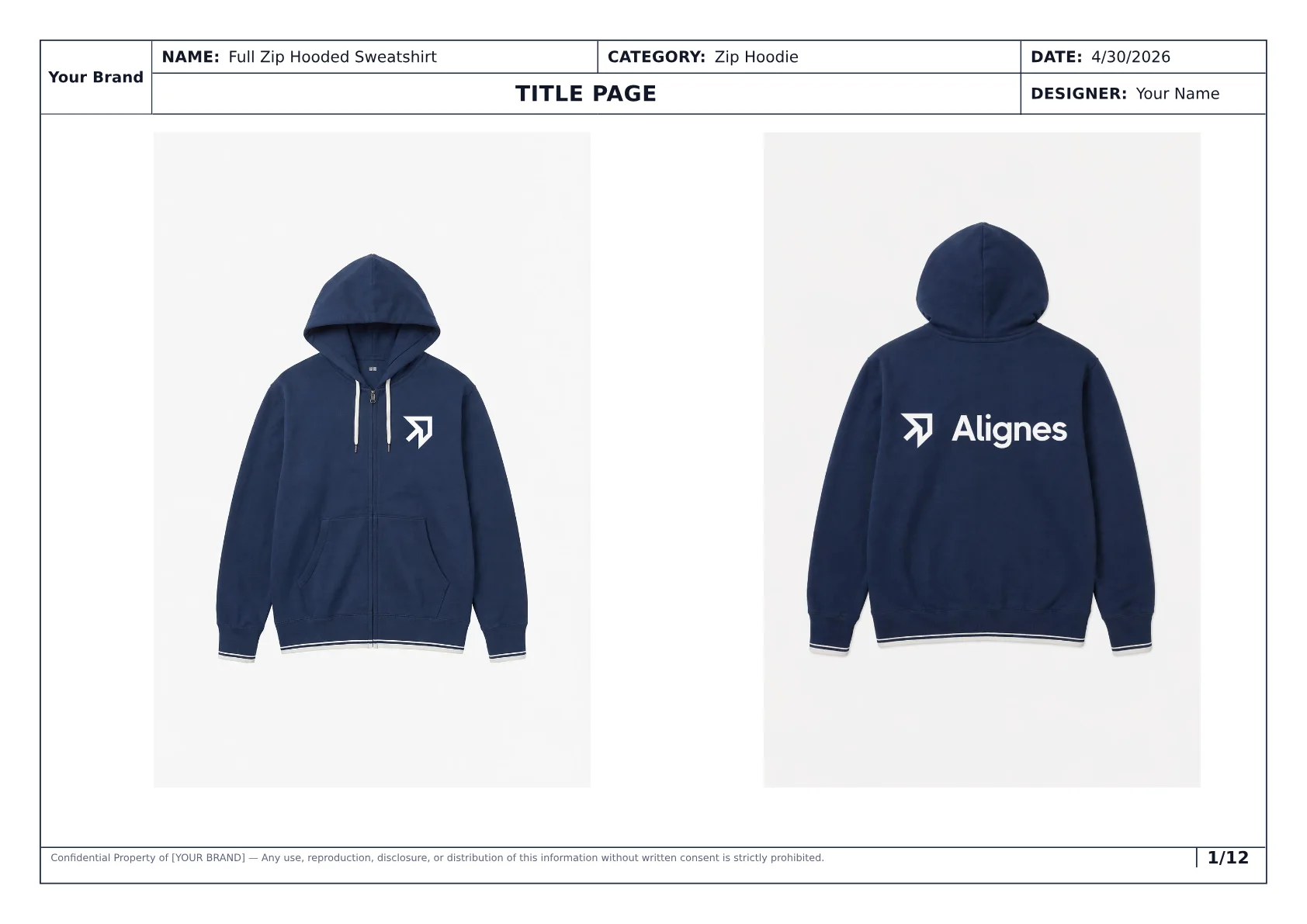
A useful example starts with style context, date, sample size, and the garment information the factory needs before reading technical pages.
What a good tech pack example proves
A strong example makes the garment inspectable.
It proves:
- what style is being developed,
- which size and size range anchor the sample,
- what the front and back views look like,
- which garment details need callouts,
- which measurements and POMs control fit,
- which materials and trims belong in the BOM,
- how the garment should be constructed,
- which colorways and artwork are included,
- what the current generated draft gives the team to review.
If the example does not answer those questions, it is probably a layout sample rather than a production example.
Page-by-page structure to expect
| Example page | What it includes | How to judge it |
|---|---|---|
| Cover or overview | Style name, category, date, sample size, size range, and garment context | The factory can identify the current style immediately |
| Reference or sketch pages | Front, back, and key views | The garment is visible without styling ambiguity |
| Callout pages | Notes attached to exact garment areas | The details are actionable, not vague |
| Measurement pages | Base-size specs, POMs, units, and graded measurements | Fit review can happen against measurable targets |
| BOM pages | Fabrics, trims, labels, hardware, artwork, and pending assumptions | Sourcing and costing inputs are visible |
| Construction pages | Seams, finishes, operations, closures, and reinforcement | Sampling teams understand how to build the garment |
| Colorway and artwork pages | Variants, placement, method, and files | Visual differences stay connected to the same style |
| Export file | Current PDF, date, and document context | The factory knows which package to use |
What weak examples hide
Weak tech pack examples often hide the parts that matter most.
Watch for:
- only a cover page and one flat sketch,
- empty measurement tables,
- generic BOM labels like "fabric" and "zipper",
- construction notes that say nothing beyond the visual,
- artwork with no size or placement context,
- no date or document context,
- no clear export package,
- no proof that the example came from real garment inputs.
Those examples may look useful at a glance, but they do not necessarily help an apparel team choose a better production workflow.
Checklist
Tech pack example scorecard
Use this when reviewing tech pack examples, template downloads, or AI-generated outputs.
Section coverage
The example includes overview, visuals, callouts, measurements, BOM, construction, colorways or artwork when relevant, and exportable structure.
Garment-specific content
The details clearly belong to the garment shown, not a generic template.
Factory-readable language
Notes describe materials, construction, and placement in practical terms.
Measurable fit control
Measurements and POMs are named well enough for sample review.
Reviewable assumptions
AI-generated or pending details are visible so the team can approve or correct them.
What an AI-generated example adds
For AI tech pack software, the example has to show more than a screenshot. It needs to reveal whether the system can create the actual document structure.
Look for generated output across:
- overview page,
- technical views,
- callouts,
- measurement tables,
- BOM,
- construction details,
- colorways,
- artwork and branding notes,
- exportable PDF or handoff format.
Output quality check
What a generated tech pack example reveals
What changes across the process
- 01
Step 01
Show the source context
Garment references, sketches, notes, materials, and color direction explain what the AI started from.
- 02
Step 02
Show the generated sections
The example includes specs, measurements, BOM, construction, callouts, colorways, artwork, and page structure.
- 03
Step 03
Show the review path
The team can inspect assumptions before sending the export to a factory.
The strongest example connects garment inputs to a filled output and then makes review before handoff explicit.
Process showing garment references becoming complete generated tech pack pages
How to use an example without copying it
Use examples to understand the expected sections and quality bar. Do not copy a garment-specific pack into a different product.
A hoodie, T-shirt, jacket, dress, and bikini each need different POM logic, construction emphasis, material choices, and artwork placement.
The real goal is not to copy the example. The goal is to create a tech pack that makes your own garment easy to inspect.
In practice
Inspect the generated hoodie example
Styneo shows a 12-page generated hoodie tech pack with overview, callouts, measurements, BOM, construction, colorways, artwork, and export-ready structure.
View the AI-generated hoodie tech packFAQ
Common questions, answered clearly.
Look for garment-specific detail, not only a layout: visuals, measurements, BOM, construction, colorways or artwork when relevant, and a clear PDF export.
Next step
Judge the output, not the claim
Styneo shows generated tech pack structure with specs, measurements, BOM, construction details, callouts, colorways, artwork, and exportable pages so teams can evaluate real output quality.