
Key takeaways
What matters before you keep reading
01
A spec sheet is usually the measurement and fit-control section inside a complete apparel tech pack.
02
Strong spec sheets define POMs, base size, values, units, grading, and review notes.
03
A spec sheet is not enough by itself if the factory also needs materials, construction, artwork, labels, and colorway information.
Reader guide
Reader guide
A quick frame before the workflow details.
For
Apparel founders, technical designers, product developers, and teams preparing fit or sample documentation.
Read when
Best read when you are building measurement specs or deciding whether a spec sheet is enough for manufacturer outreach.
You'll get
A clear definition, section breakdown, tech pack comparison, and a review checklist for apparel spec sheets.
On this page
Follow the article through the long read and keep your place.
On this page
6 sections
An apparel spec sheet is the part of the handoff that makes the garment measurable. It defines how the sample should be checked, which measurements matter, and whether the factory has enough information to control fit.
A spec sheet is more than a template. A useful spec sheet is filled with garment-specific measurements, named points of measure, units, grading, and notes that tie back to the current garment.
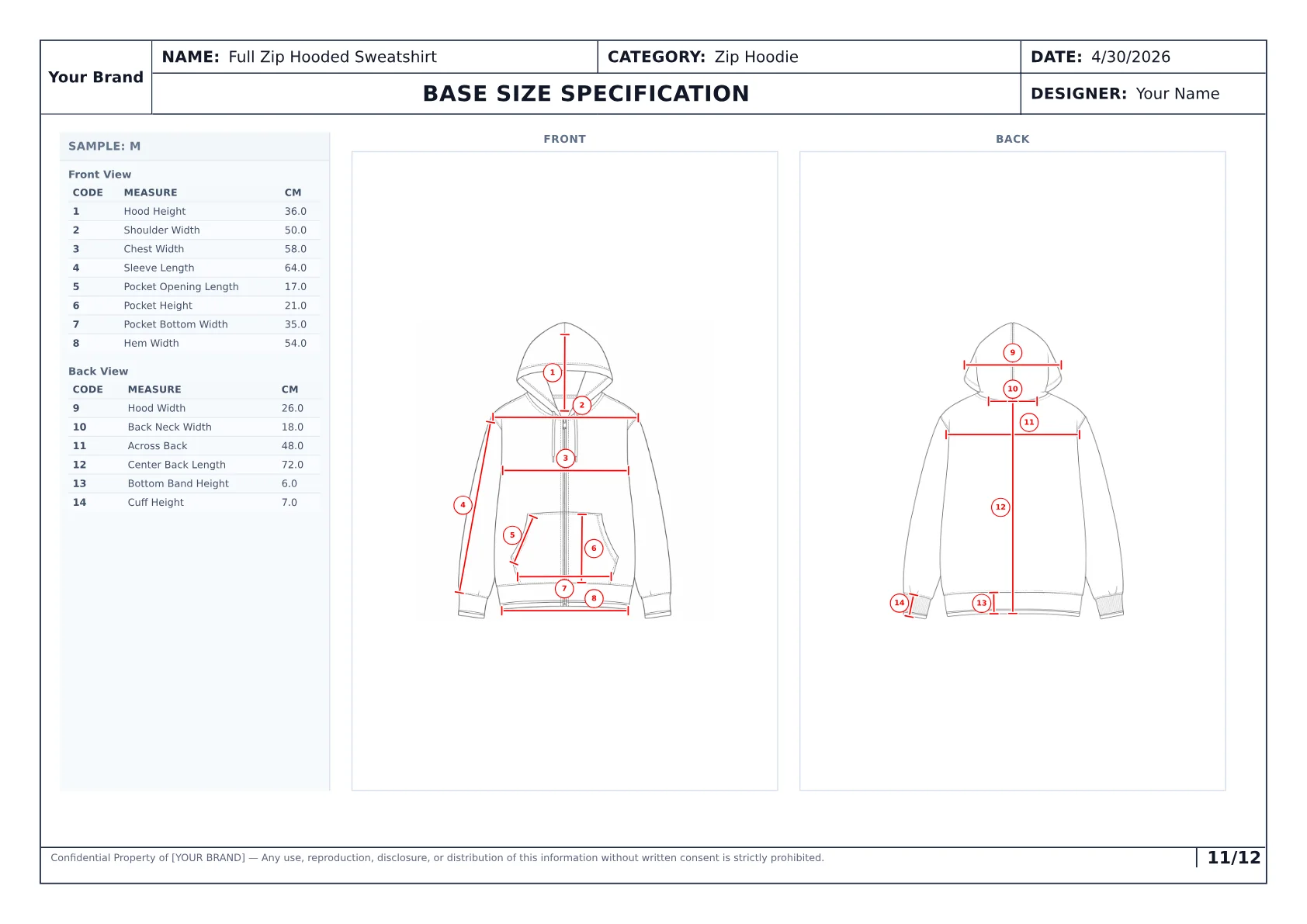
In a complete tech pack, the spec sheet should give the factory measurable targets for sample review and quality control.
Spec sheet definition
A spec sheet is a structured measurement page for a garment. It tells the factory what to measure and how to interpret the measurement.
At minimum, it should include:
- sample size,
- size range or graded measurement logic,
- measurement names,
- points of measure,
- values,
- units,
- fit or review notes.
The spec sheet helps teams compare the intended garment with the physical sample. Without it, fit feedback becomes subjective.
Spec sheet vs tech pack
The spec sheet is important, but it is not the whole production document.
Comparison
Spec sheet vs full tech pack
A spec sheet controls fit and measurements. A tech pack controls the broader garment handoff.
| Topic | Spec sheet | Full tech pack |
|---|---|---|
| Main role | Defines measurements, POMs, units, grading, and fit notes. | Defines visuals, specs, BOM, construction, colorways, artwork, labels, packaging, and export context. |
| Factory use | Helps sample review and quality control. | Helps quoting, sampling, sourcing, construction, review, and production handoff. |
| Risk if incomplete | Fit feedback becomes subjective or inconsistent. | The factory must guess across materials, construction, artwork, and garment context. |
| Best use | One section inside the current garment handoff. | The source document that connects every garment decision. |
What a spec sheet should include
A good apparel spec sheet is specific enough that two people can measure the same sample and understand what they are checking.
Include these fields:
| Field | Why it matters |
|---|---|
| Sample size | Anchors the measurements to one base size |
| Size range | Shows whether the spec is for one sample or a graded style |
| POM name | Names the measurement clearly |
| POM instruction | Explains where and how to measure |
| Measurement value | Gives the target spec |
| Unit | Prevents inch/centimeter confusion |
| Optional tolerance note | Defines acceptable deviation when the factory or QC stage requires it |
| Notes | Captures fit, review, or construction context |
Points of measure
Points of measure are the named places where measurements are taken.
Common POMs include:
- body length,
- chest width,
- shoulder width,
- sleeve length,
- cuff opening,
- waist,
- hip,
- inseam,
- rise,
- leg opening,
- hem width.
The right POMs depend on the garment category. A hoodie, dress, jacket, bikini, and pair of jeans will not use the same spec logic.
Grading and optional tolerance notes
Grading defines how measurements change across sizes. Tolerance notes define the acceptable range around a measurement when the factory or QC stage requires that level of control.
If grading is ready, the spec sheet shows the graded values. If grading is not ready, the pack says so instead of letting the factory assume.
A common mistake is to send one base size with no size-range context. That may be enough for an early sample, but it is not enough for a serious production handoff.
How AI-generated specs should be reviewed
AI can make the first spec draft faster, but the output still needs human review.
When reviewing AI-generated measurements, check:
- whether the POMs match the garment category,
- whether the units are correct,
- whether the measurements are plausible,
- whether graded measurement logic is clear,
- whether construction details affect where measurements should be taken,
- whether the measurement page matches the latest garment direction.
Measurement quality control
Review generated specs before handoff
What changes across the process
- 01
Step 01
Generate the measurement draft
The system creates a first version of POMs, values, units, and size logic from garment references and notes.
- 02
Step 02
Review garment fit logic
The team checks whether the measurements and POMs match the intended silhouette and sample stage.
- 03
Step 03
Export the current PDF
The reviewed spec sheet travels with the full tech pack so the factory sees context, not isolated numbers.
A generated spec sheet should shorten the first draft, not remove technical review.
Process showing generated spec draft reviewed before factory handoff
In practice
See a spec sheet inside a generated tech pack
The hoodie example shows how the measurement page sits alongside callouts, BOM, construction details, colorways, artwork, and export-ready pages.
View the hoodie tech pack exampleFAQ
Common questions, answered clearly.
No. A spec sheet focuses on measurements and garment specifications. A tech pack is broader and usually includes visuals, callouts, BOM, materials, construction, artwork, labels, colorways, packaging, and export notes.
Next step
Generate specs inside the complete tech pack draft
Styneo creates structured tech pack drafts that include measurement pages, POMs, BOM, construction details, callouts, colorways, artwork, and export-ready pack structure.